Eli Lilly (LLY): A Magnificent Business, Priced for It
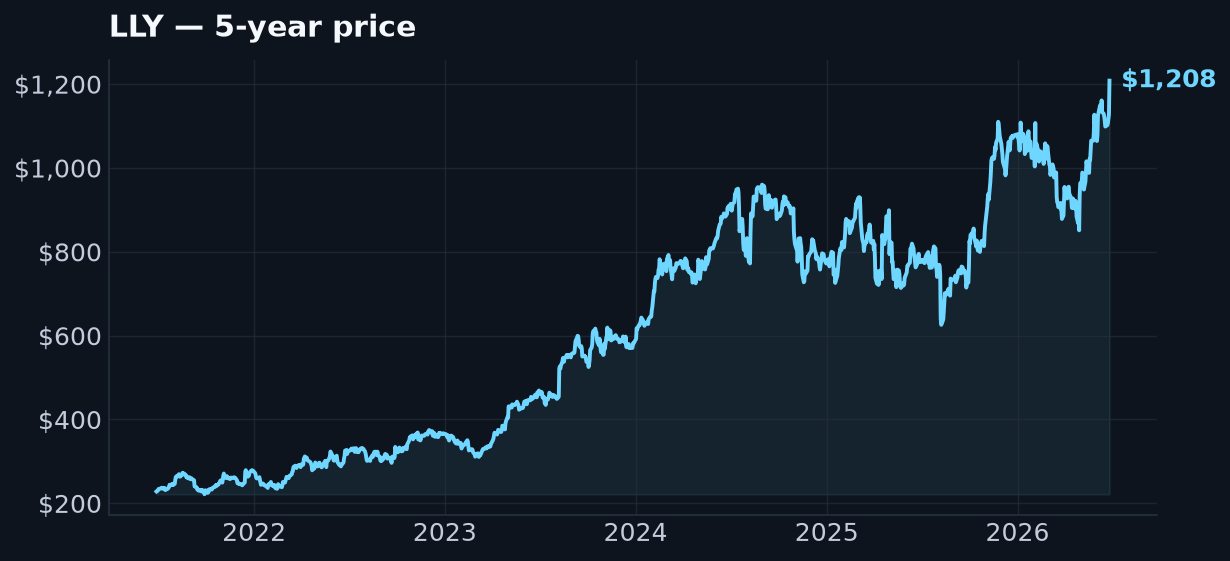
Synthos Research — Company Deep Dive · Price at analysis: $1,206.51 · Market cap: $1,136B · Healthcare / Drug Manufacturers
The bottom line
| Synthos rating | |
|---|---|
| Exponential Potential | 87 / 100 — Exceptional (growth 100 · quality 86 · expert conviction 88 · moat 62 · optionality 91) |
| 5+ year rating | Buy — 4/5 conviction (elite business, fair valuation) |
| Near-term entry zone | $1,092 – $1,148 (a pullback toward the rising 50-day average ~$1,031; at $1,207 the stock is extended) |
| Valuation verdict | FAIR / MIXED — a magnificent business already priced for its bull case |
Exponential Potential — 87/100. Synthos's fusion score blends the hard numbers with what the expert corpus actually says. LLY's score is driven by a maxed-out growth trajectory, 30% ROIC, and enormous optionality — a 20M→100M-patient GLP-1 TAM plus gene-editing (Verve) and AI-discovery bets. The one moderating pillar is network effects (62): Lilly's edge is a franchise + manufacturing-scale moat, not a true self-reinforcing network. (Grounded in 8 passages retrieved from the medicine + investing brains.)
Lilly is one of the highest-quality compounders in the market — but at $1,207 the stock already embeds the bull case. On its own history it looks reasonable; on absolute cash flows it looks expensive. Both are true, and the gap between them is the investment debate.
What the business is doing
| Metric | Historical (5y) | Forward (analyst) |
|---|---|---|
| Revenue growth | +21.6%/yr | +15.1%/yr |
| EPS growth | +28.8%/yr | +22.6%/yr |
| ROIC (latest) | — | 30.2% |
| FCF margin (median 4y) | 7.3% | (depressed by capex) |
This is elite. A company compounding earnings >20% with a 30% return on invested capital is rare, and the metabolic/GLP-1 franchise is the engine. The one blemish — a 7.3% free-cash-flow margin — isn't a profitability problem; it's a timing one. Lilly is pouring cash into manufacturing capacity to meet GLP-1 demand, which temporarily crushes FCF even as net margins run north of 20%.
Is it cheap or expensive? Three lenses.
1. Versus its own history — reasonable.
| Multiple | Now | Own 5y median | Forward |
|---|---|---|---|
| P/E | 52.6× | 51.5× | 33.0× |
| EV/EBITDA | 35.8× | 38.8× | 36.6× |
| P/FCF | 126.6× | 62.2× | n/a (capex) |
On a forward P/E of 33× — versus a 51× five-year norm — you're paying less than usual for Lilly's earnings. The PEG ratio is 0.9 (forward P/E ÷ ~36% near-term EPS growth): below 1.0 is the classic "cheap for the growth" signal. The lone red flag is P/FCF at 126× — the capex story again, not durable.
2. Versus a discounted-cash-flow model — expensive.
A two-stage DCF — analyst revenue estimates drive 2026–2030, growth fades to a 2.5% terminal rate, and (critically) the FCF margin ramps from today's 7% up to 23%, modeling the capex cycle normalizing toward Lilly's proven net margin — a generous assumption, not a conservative one:
- Base-case fair value: ~$579/share (WACC 6.8%, terminal growth 2.5%)
- Versus $1,207 today → the model implies ~50% downside.
3. Sensitivity — what would justify today's price? (fair value $/share)
| WACC ↓ \ terminal growth → | 1.5% | 2.0% | 2.5% | 3.0% | 3.5% |
|---|---|---|---|---|---|
| 5.3% | $707 | $814 | $959 | $1,169 | $1,495 |
| 6.0% | $568 | $639 | $729 | $849 | $1,016 |
| 6.8% (base) | $470 | $519 | $579 | $656 | $756 |
| 7.5% | $396 | $432 | $475 | $528 | $593 |
| 8.3% | $340 | $367 | $398 | $436 | $482 |
To reach ~$1,207 from cash flows, you need the top-left corner: a low ~5.3% discount rate and 3%+ perpetual growth — on top of margins tripling to 23%. Not impossible, but it leaves no margin for error.
Relative performance
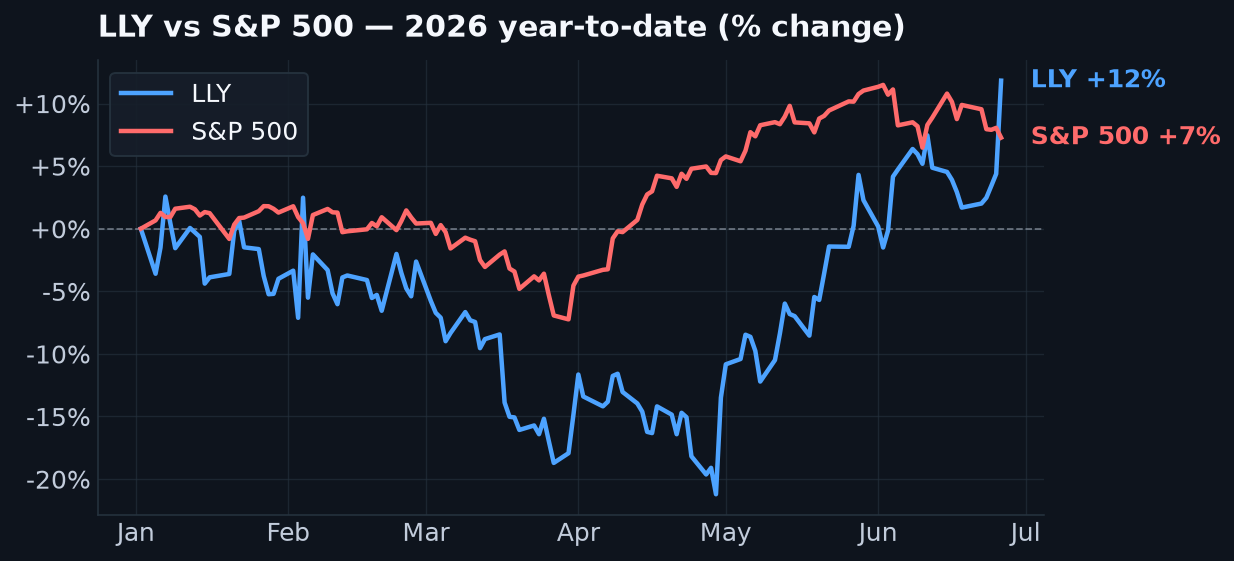
Year-to-date, LLY round-tripped from −21% back to leadership — it now outperforms the S&P 500 after a brutal first quarter:
Reconciling the two answers
The relative lens (cheap-ish) and the absolute lens (expensive) disagree because the market is pricing in more than the analyst consensus already embeds: terminal margins above 23%, growth that stays high well past 2030, or a discount rate that reflects how safe investors consider this franchise. The forward P/E looks cheap precisely because analysts model enormous near-term earnings growth — the DCF just asks whether that growth, fully extended, is already in the price. It mostly is.
The bull / bear in one breath
- Bull: GLP-1 is a multi-hundred-billion TAM; oral formulations and new indications (sleep apnea, MASH, early Alzheimer's, anti-obesity-as-healthspan) extend the runway; 30% ROIC means reinvestment compounds. Capex normalizes, FCF explodes, and 2030 isn't the end — so terminal value is understated.
- Bear: any DCF that needs a 5% discount rate and perpetual 3% growth to work is priced for perfection. Competition (Novo, plus a wave of oral/next-gen entrants), pricing/political risk, and manufacturing execution are all live. At 33× forward earnings, a single guide-down re-rates the stock hard.
What would change the view
- FCF inflection — the quarter capex peaks and FCF margin turns up toward the teens is the single most important datapoint; it's the hinge of the thesis.
- Estimate revisions — if 2027–2030 estimates keep climbing, the "expensive on DCF" gap closes from the numerator, not the price.
- A pullback into the entry zone (~$1,090–1,150, toward the rising 50-day) converts this from "great company, full price" to "great company, fair price" — which is exactly why the rating is Buy on accumulation, not chase.
Methodology: FMP fundamentals + consensus analyst estimates; two-stage DCF with a WACC×terminal-growth sensitivity grid; multiples judged against the stock's own trailing history; rating = business-quality × valuation, entry from price technicals. Assumptions are explicit and adjustable in the Synthos valuation engine.
Disclaimer. Synthos Research is independent research for educational and informational purposes only. This is not investment advice, a solicitation, or a recommendation to buy or sell any security, and it is not personalized to your situation. A DCF is only as good as its inputs, and analyst estimates are frequently wrong. Do your own due diligence and consult a licensed professional. The author may hold positions in securities discussed.