Circle (CRCL): A Real Theme, a Questionable Vehicle
Synthos Research — Company Deep Dive · Price at analysis: $75.96 · Financials / Stablecoin infrastructure · IPO'd June 2025
The bottom line
| Synthos rating | |
|---|---|
| Exponential Potential | 48 / 100 — Limited (growth 99 · quality 16 · expert conviction 25 · moat 35 · optionality 48) |
| 5+ year rating | Avoid / Speculative — bullish the theme ≠ bullish this vehicle |
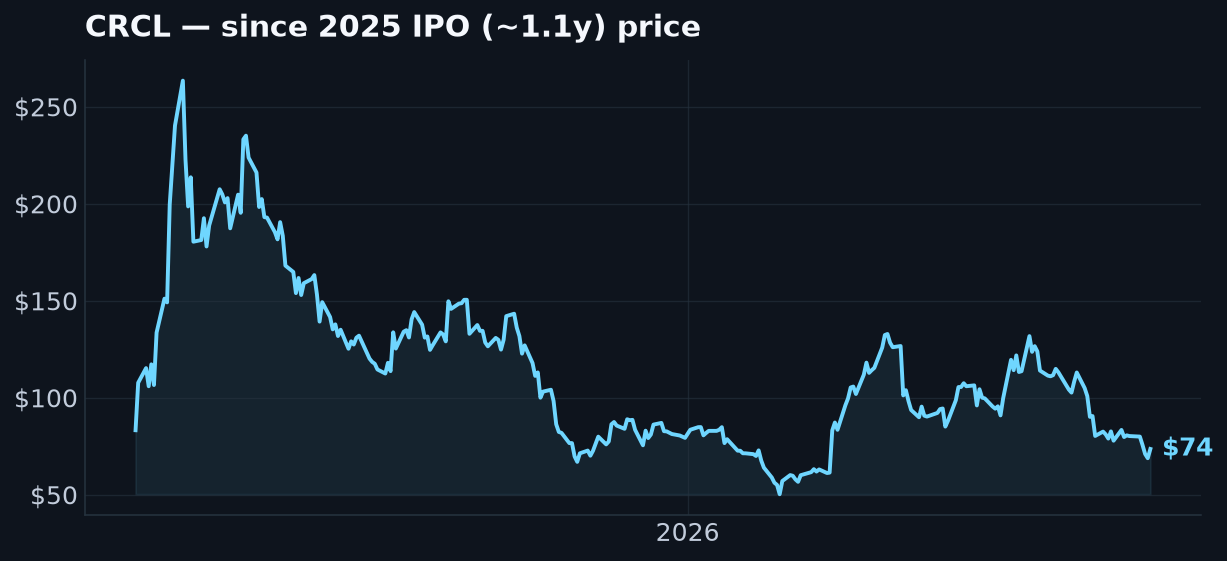
| Near-term entry | No compelling entry. It has fallen below its 50-day (~$99) for real reasons; theme-believers should size small and treat it as venture-risk |
| Valuation | A standard DCF doesn't fit — judge it on reserves × take-rate × interest rates, not P/E |
Circle is the issuer of USDC, the #2 stablecoin, and it IPO'd in June 2025 straight into the stablecoin mania. The theme — dollars on a blockchain — is one of the most exciting in finance. But our fusion score lands at a sober 48/100 (Limited), and the gap between "great theme" and "great stock" is the whole story here.
The bull case (it's real)
- Stablecoin TAM is exploding. On-chain dollars are becoming the rails for payments, trading, and cross-border flows — a multi-trillion-dollar opportunity.
- The GENIUS Act gave US stablecoins a legal framework, legitimizing regulated issuers and (in theory) favoring a compliant player like Circle over offshore rivals.
- USDC is the institutional, regulated choice — multi-chain, transparent reserves, the stablecoin a US bank or fintech is most likely to touch.
If you simply believe "stablecoins go up and to the right," Circle looks like the picks-and-shovels way to own it.
The reality (why the score is Limited)
Here's what the numbers and the expert corpus actually say — and it's more sobering:
- It's an interest-income business, so it's rate-sensitive. Circle earns yield on the reserves backing USDC. That's a wonderful model at 5% rates — and a shrinking one as the Fed cuts. Its earnings are a leveraged bet on interest rates staying high, which is a strange thing to own if you think rates fall.
- It doesn't keep most of the yield. Circle shares a large cut of reserve income with distribution partners (notably Coinbase). The take-rate on those reserves is thin and contested — revenue can boom while economics stay mediocre. That's the quality score of 16 talking.
- USDC is losing share, and stablecoins are a commodity. Tether (USDT) dominates; new entrants keep arriving. A dollar is a dollar — there's little to stop users from switching. The moat score of 35 reflects compliance-as-edge, not a true network-effects lock-in.
- The experts are skeptical on Circle specifically. Across the crypto and investing brains, the read is consistent: TAM exploding, but USDC seen ceding share, "forced to pass back yield," an infrastructure laggard. Conviction: 25/100.
Relative performance
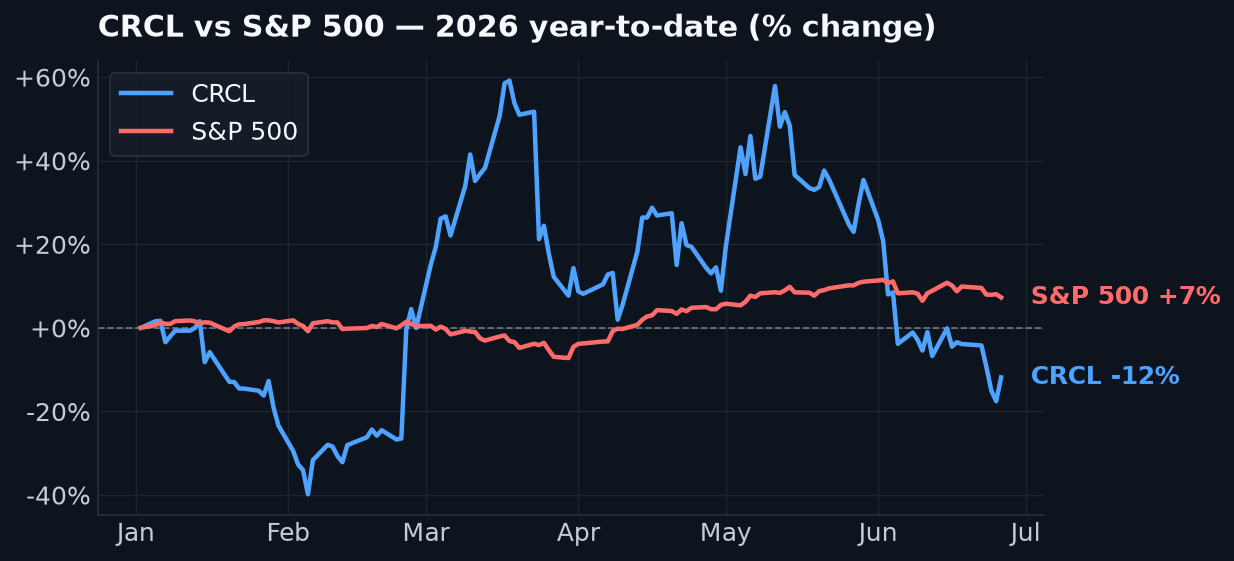
The market has already started voting. Since its IPO and year-to-date, CRCL has underperformed — down ~12% while the S&P is up ~7%:
Why we won't pretend to give it a precise DCF
Honesty matters more than false precision. With ~1 year of public history and an interest-income model, a standard discounted-cash-flow or "P/E vs. its own history" is meaningless for Circle (our engine literally produced a +422% "fair value" and a "+4,000% vs history" multiple — artifacts, not analysis). The right lens is structural: reserves under management × the take-rate Circle keeps × the level of interest rates. All three are uncertain, and two of them (take-rate, rates) point the wrong way.
Verdict
A genuinely exciting theme strapped to a questionable vehicle. Circle is a high-growth, low-quality, thin-moat, rate-sensitive commodity issuer that the smart money is skeptical of — and the stock has already fallen below key support. Exponential Potential 48/100 (Limited); rating: Avoid / Speculative. You can be very bullish on stablecoins and still pass on Circle.
What would change the view: durable USDC share gains (not just TAM growth), a real moat beyond compliance, an improving take-rate, or a price that discounts the rate-cut risk. None of those are visible yet.
Methodology: FMP fundamentals; Exponential Potential = quant trajectory/quality fused with qualitative pillars (expert conviction, network effects, optionality) scored over retrieved passages from the crypto, investing, and macro knowledge brains. Where a DCF doesn't fit the business model, we say so rather than fabricate one.
Disclaimer. Synthos Research is independent research for educational and informational purposes only. This is not investment advice, a solicitation, or a recommendation to buy or sell any security, and it is not personalized to your situation. Do your own due diligence and consult a licensed professional. The author may hold positions in securities discussed.